Showing posts with label Wrist. Show all posts

Wednesday, 31 May 2017

Friday Q A Wrist Flossing


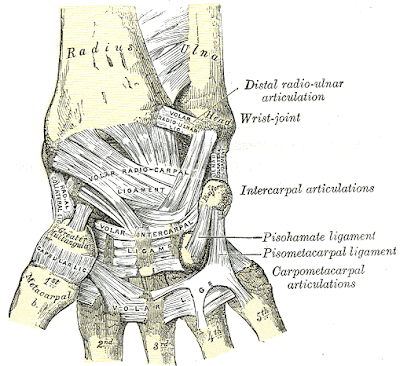
Q: I teach a chair yoga class. Last week I led my students in the "wrist flossing" exercise described on this web site (see Featured Sequence: Wrist Flossing for Wrist Care) and also in Timothy McCall’s "Yoga As Medicine."

A new student came up after that class to challenge me in using this sequence. She had had carpal tunnel surgery 6 months ago. She said that her surgeon said that people should never, never, never, put pressure on their hands while bending the wrists back, and that the wrist flossing we did was very dangerous. Her surgeon apparently says that bending the wrists back on their own is OK, but applying any pressure is very wrong. My student claims that poses like down dog, plank, even being on hands and knees, would make her surgeon shriek in horror.

If someone has no wrist problems, is there any danger in such positions?

I told my student that she is free to avoid doing such movements but that I will continue to have the class do the wrist flossing exercise occasionally. But I wonder...when should this NOT be done?

A: I want start by saying that for students with healthy wrists, wrist flossing, done appropriately and not excessively, poses no danger to the wrist joint, nor for that matter should positions such as Downward-Facing Dog pose, Plank pose, Cat/Cow pose or other positions when the wrist is in the position known as "extension." Having said that, keep in mind that too much of any position could be a problem if someone has sensitive wrists that are prone to episodes of soreness or pain.
Wrist Flossing
Secondly, I would point out that the yoga teacher who developed wrist flossing is also a chiropractor who sees many, many patients who present with wrist pain and overuse issues related to the wrists from computer work and other repetitive activities. You can read more about Tom Alden in Timothy’s book, but he claims to have good results in improving function and decreasing pain teaching this technique. I have had a few students with wrist pain from excessive keyboarding or activities like rock climbing, which is intense for the hands and wrists, and have taught them wrist flossing without problems, and with improvement in their symptoms.

I cannot comment directly on what your student’s surgeon said or implied (since I was not there!), although it sounds like the student felt the warnings were quite serious. I will comment on the wrist movements she referred to: “bending the wrists back on their own is OK, but applying any pressure is very wrong.” Bending the wrists back on their own into “extension” in situations when your wrists are not bearing weight, for example, with your right hand when you arm is in the air, and you do this with the muscles in right arm and hand area alone, is called “active range of motion.” If you then, at that point in your wrist’s range of movement, bring your left hand over and bend your wrist more deeply into extension by applying pressure with your hand onto your right hand, the wrist will likely go a bit further. This additional movement is called “passive range of motion,” and it could allow you to stretch your forearm muscles a bit more deeply, which could have a nice benefit. However, if I were significantly injured or just out of surgery for carpel tunnel syndrome, I’d want to be very cautious of this, as it could aggravate things. Even with the wrist flossing instructions that I learned, the emphasis is on using the passive range of motion on the wrist that is bending into flexion, not the one going into extension.

I hope this additional information will allow you all to feel more comfortable teaching and/or doing wrist flossing.

Finally, yoga teachers should always encourage students to let them know about injuries, surgeries and health issues at the start of every class. And yoga students should please let your teachers know ahead of time what is going on with you! It sounds like the student that the teacher wrote about didn't let her teacher know about her wrist problems until after class. This happens to me all the time and is a bit frustrating—so hard for me to offer modifications after the fact! 

—Baxter

Subscribe to Yoga for Healthy Aging by Email ° Follow Yoga for Healthy Aging on Facebook ° Join this site with Google Friend Connect 

Monday, 24 April 2017

Wrist Pulse Oximeters Are Important Devices


By Tracie Knight


There is a monitoring technique that has been used exclusively for operations. For many years now, when a person is under anesthesia, they have significantly slowed breathing. After collecting the data, the machine displays it and a notification is made with some sound. Due to its accessibility, this device can be seen in many patients' beds, but now- wrist pulse oximeters are available to normal people.

There are a number of diseases associated with chronic lack of oxygen (hypoxia) in which this unit's figure requires constant monitoring and accurate data, which significantly complicates the need to obtain treatment. A simple to use device, which is made by specialists in the field of medicine and computer technology, today is an indispensable instrument for the implementation of a single measurement as well as for long-term monitoring (continuous monitoring) of your saturation levels and heart rate. The method of obtaining the data is non-invasive (not requiring blood samples for the study), it measures the desired values quickly, facilitating the task of the diagnostician.

The advantage of these units is that it is not necessary to take blood from the arteries. In addition, the device can retrieve and process the data output to the display device, even if the patient is unconscious.Individual units can be recommended for those patients who have been assigned with oxygen therapy on an outpatient basis. The device in this case will provide the greatest efficiency of treatment by measuring and controlling the necessary indicators.

When choosing a device, you need to determine several factors. Consider why you need this device, whether for a measurement in a single instance, or constant monitoring is actually needed. Decide if you will continuously monitor how and where it will be used and if there is a need for sensors to alert you immediately about irregularities.

In hospitals, the same protection against damage is not so necessary.There first place is given to the instrument's functionality, and this creates more cumbersome, but more multi-functional devices.In life, there are different situations and sometimes, there is an urgent need for hospitalization, and everyone's life just stops.

The device measures the saturation of the hemoglobin in your arterial oxygen. It also measures your pulse rate - how many beats per minute your hear makes. It is used for the assessment of function of the respiratory system, for chronic obstructive pulmonary disease, in anesthesiology, for TB and more. The official name relates to devices without their introduction into the body, ie the use of non-invasive methods, so their use is quite easy and not one that needs special skills.

The device collects all data during your cycle of daily activities and the main system's processor displays all information about your state of being.It takes into account the parameters set exclusively for your arterial blood. All readings are collected and on the basis of these indications, treatments can be selected and oxygen therapy undertaken.

With the latest technology, the patient performs all measurement for themselves in a very short time - just a few seconds. The more complex models are used in anesthesiology, awakening from intensive therapy, patient transport, etc.Any device must be equipped with standard features, to let it work to its maximum potential.


About the Author: